

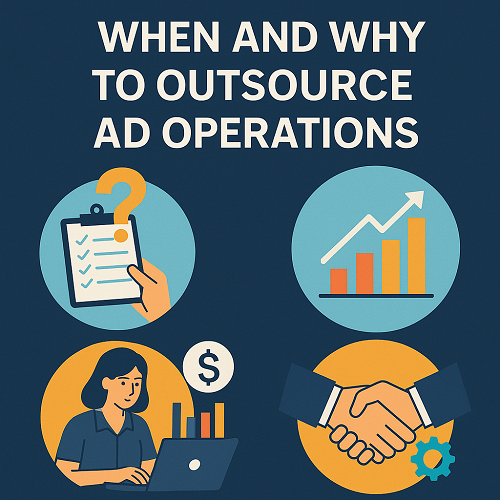
Executing a successful ad campaign requires more than just creative ideas — it demands precision, technical know-how, efficient workflows, and consistent optimization. Looking ahead to 2026, many organizations might consider the option of outsourced ad ops as a viable strategy. That’s why many organizations face a critical decision: build an in-house ad operations team, or outsource ad operations to a third-party specialist.
Outsourcing ad operations isn’t merely a cost decision — it can be a strategic lever for scalability, speed, performance, and competitive advantage. But when exactly does it make sense to outsource? And how can you ensure you’re selecting the right partner or model?
This article goes beyond the surface-level benefits and offers a decision framework — with concrete criteria, key questions, risks, optimization strategies, and recommendations — to help you determine whether outsourcing ad operations is right for your business now.
What Is “Ad Operations” — And What Does Outsourcing It Involve?
Before diving into why and when to outsource, it’s essential to define what “Ad Operations” (AdOps) encompasses and what “outsourcing” it really means.
- Ad Operations refers to the end-to-end execution and management of digital ad campaigns. This includes tasks such as ad trafficking and setup, inventory management, yield optimization, campaign monitoring, reporting, troubleshooting, compliance, and analytics.
- Outsourcing Ad Operations means contracting a third-party provider (agency, specialist vendor, or managed services firm) to handle some or all of those tasks — instead of building or maintaining an in-house AdOps team.
Outsourcing can take different forms depending on your business model:
- Fully outsourced — the external partner handles everything, from setup to optimization and reporting.
- Hybrid / augmented — your in-house team handles strategy and core tasks, while a partner fills in specialized or resource-intensive parts (e.g., trafficking, yield optimization, scaling).
- On-demand or “just-in-time” outsourcing — using external resources for spikes in workload (e.g., seasonal campaigns, unexpected volume increases) rather than maintaining a full-time internal team. This aligns with the broader business strategy of “on-demand outsourcing.”
Why Many Companies Outsource Ad Operations: Key Benefits
Outsourcing AdOps isn’t just about cutting costs — it delivers a range of strategic benefits for advertisers, publishers, and media agencies alike.
Access to Specialized Expertise & Advanced Tools
Digital advertising technology, programmatic frameworks, ad servers, and yield optimization tools evolve rapidly. An external AdOps team often brings deep expertise, up-to-date knowledge of platform changes, and experience managing complex campaigns — exceeding what many in-house teams can achieve.
This often leads to more effective campaigns, better yield, and fewer technical errors.
Cost Efficiency & Lower Overhead
Building and maintaining an in-house AdOps team involves hiring, training, salaries, benefits, equipment/software, and overhead. Outsourcing converts that fixed cost into a variable cost — you pay for services when you need them, potentially saving up to 50% compared to in-house staffing.
Moreover, an external partner can spread their operating costs across multiple clients — delivering economies of scale that smaller publishers or agencies couldn’t access alone.
Scalability and Flexibility to Match Demand
Whether you’re scaling campaigns fast, handling spikes in traffic, or running seasonal promotions — an outsourced model lets you ramp up (or down) quickly without hiring lag or overhead investment.
This flexibility is particularly valuable for businesses with fluctuating ad workloads.
Focus on Core Competencies and Strategic Priorities
When you outsource AdOps, your internal team can focus on core business functions — such as overall marketing strategy, creative development, sales, product, or customer experience — instead of technical ad execution. This reallocation enhances productivity and drives innovation.
Faster Time-to-Market
With seasoned experts managing trafficking, setup, and optimization, campaigns can be launched and adjusted much faster than if built from scratch internally — enabling quicker adaptation to market changes, competitor moves, or new business opportunities. This speed and agility can yield a competitive edge.
When (and Under What Conditions) It’s Time to Outsource AdOps — Decision Triggers & Signals
Outsourcing doesn’t suit every business — but there are clear signs and threshold conditions indicating that external AdOps might be the right move. Use the following decision-framework to assess if you should outsource now.
| Trigger / Signal | Why It Matters |
|---|---|
| Limited internal resources or expertise (small team, no experienced AdOps staff, lack of ad-tech know-how) | Running advanced ad campaigns requires technical skills and time — outsourcing solves the skills gap and frees up bandwidth. |
| The cost/overhead of building and maintaining in-house team becomes unsustainable | Outsourcing shifts fixed costs (salaries, tools, training) to variable costs; saving overhead and risk. |
| You need scalability, flexibility, or have fluctuating ad volume (e.g. seasonality, growth spikes) | An outsourced partner lets you scale up or down without hiring or layoffs. |
| ROI, yield, or ad performance plateau or decline — despite internal efforts | External squads often bring fresh perspectives, optimization skills, better yield management and revenue maximization experience. |
| Your team is overburdened by technical / non-core tasks (trafficking, reporting, yield ops) | Outsourcing frees internal capacity to focus on core strategy and high-value initiatives. |
| Need for speed and agility (new campaigns, rapid iterations, multiple channels/platforms) | Outsourced experts can deploy faster, optimize across multiple platforms, and implement best practices rapidly. |
| The complexity of ad tech and programmatic landscape exceeds internal capacity (multiple ad servers, DSPs/SSPs, compliance, yield optimization, reporting) | Outsourcing ensures the ad-tech complexity is handled by experienced professionals. |
If your business meets two or more of these conditions — especially resource limits plus growth, performance pressure, or scaling demand — outsourcing begins to look not just advisable—but strategically necessary.
Potential Downsides & Risks — What You Must Watch Out For
Outsourcing isn’t a silver bullet. There are important risks, trade-offs, and pitfalls to consider:
Loss of Control & Transparency
When handing over ad operations to an external partner, you may lose some direct control over day-to-day execution, reporting, and ad inventory. This can lead to issues around transparency — especially if the vendor provides only net revenue (versus gross), or uses black-box reporting.
Lack of clarity can erode trust and make it hard to audit performance or verify revenue splits.
Dependence on a Third-Party — Vendor Risk & Lock-in
Outsourcing ties a portion of your ad revenue (and operations) to an external provider. If the partner underdelivers, mismanages campaigns, or their business falters — your ad operations may be disrupted. Plus, switching providers can be costly or complicated once workflows are embedded. This is a classic risk in outsourcing/global business operations.
Potential Misalignment with Business Goals or Brand Strategy
An external AdOps provider may not fully understand your brand positioning, business priorities, or core audience — particularly if they serve many clients across industries. This can result in generic campaigns, suboptimal UX/ad placements, or lack of strategic alignment.
Communication & Coordination Overhead
Even the best partner can only work well if communication is clear, frequent, and well-structured. Poor communication can lead to misunderstandings about targeting, creative, optimization priorities, or performance expectations.
Data Security, Privacy & Compliance Concerns
Outsourcing may involve sharing sensitive data, user info, or ad analytics — which makes data security, compliance (e.g. GDPR, CCPA), and ethical use of data critical. Third-party vendors need robust governance to avoid regulatory or privacy mishaps. (A general risk in any third-party outsourcing scenario.)
Because of these risks, outsourcing should not be an ad-hoc or impulsive decision — but a deliberate, well-governed strategic move.
How to Decide: Your Strategic Outsourcing Decision Framework
Here’s a step-by-step decision framework (with questions and evaluation criteria) to help you determine whether outsourcing AdOps is right for your organization — and what model suits you best.
1. Audit your current AdOps performance & capacity
- Do you have internal staff dedicated to ad operations — and are they skilled enough?
- Are your campaigns meeting yield, ROI, and performance targets?
- Is campaign setup, trafficking, optimization, and reporting creating bottlenecks?
- Is your ad-tech stack becoming too complex to manage in-house (multiple DSPs, ad servers, yield tools)?
If the answer to any is “no” or “needs improvement,” flag outsourcing as a potential strategic move.
2. Evaluate business growth trajectory and forecast demand
- Are you expecting growth in ad volume, traffic, or campaigns (e.g. entering new markets, scaling media spend, seasonal peaks)?
- Do you anticipate variability or spikes in demand that would be hard to accommodate with a fixed internal team?
If growth or variability is on the horizon, outsourcing offers scalability and flexibility.
3. Determine cost-benefit: In-house vs Outsourced
- Calculate all in-house costs: salaries, benefits, software licenses, infrastructure, training, management overhead.
- Estimate the cost of outsourcing — including vendor fees, potential markup, and any transition/onboarding costs.
- Compare both scenarios in terms of ROI, operational efficiency, and long-term flexibility.
If outsourcing presents a lower total cost of ownership for comparable or better performance — it’s a strong argument for going external.
4. Identify non-core vs core competencies & strategic priorities
- Which parts of AdOps are truly core to your growth or competitive advantage (e.g., strategic targeting, creative strategy, data-driven optimization)?
- Which are technical, repetitive, or resource-intensive but not core (e.g., trafficking, yield optimization, reporting)?
Consider outsourcing non-core but resource-heavy tasks — while retaining core strategic control internally.
5. Vet potential outsourcing partners thoroughly
Key criteria to evaluate:
- Deep experience and proven track record in managing ad operations across platforms and industries.
- Transparency in reporting, revenue sharing, fees — ideally, gross revenue visibility rather than “black-box” net reporting.
- Clear communication protocols, service-level agreements (SLAs), and alignment with your business goals.
- Flexibility and scalability to match changing campaign demands, growth, or seasonal shifts.
- Data security, compliance, and governance processes if handling sensitive or regulated data. (Particularly important depending on your industry or geo.)
6. Choose the outsourcing model that fits your needs
| Model | Best Suited For |
|---|---|
| Full outsourcing (end-to-end) | Companies with minimal internal AdOps capacity, rapid scaling needs, or want to avoid overhead completely. |
| Hybrid outsourcing | Organizations with some internal talent — using external support for scale, complexity, or specialized tasks (e.g., programmatic, yield ops). |
| On-demand / seasonal outsourcing | Businesses with fluctuating ad volumes — e.g. seasonal campaigns, spikes — who don’t want to maintain a full-time internal team. |
How to Maximize Value from Outsourcing — Best Practices & Recommendations
Outsourcing successfully isn’t just about signing a contract — it requires governance, strategic alignment, and ongoing collaboration. Here are best practices to get the most value:
- Define clear objectives, KPIs, and success metrics before engaging a partner (e.g. yield targets, CPM/CPV thresholds, throughput, reporting cadence). This ensures both parties have aligned expectations.
- Establish transparent reporting and communication protocols — ask for detailed gross-revenue reporting, clear breakdown of fees, regular check-ins, and campaign auditability.
- Maintain strategic oversight internally — while outsourcing operational execution, keep strategic control of targeting, creative, brand voice, budget allocation and optimization priorities.
- Perform periodic reviews and audits — evaluate performance, compliance, and alignment with business goals regularly (quarterly or per campaign).
- Ensure flexibility and exit/transition clauses — avoid long-term lock-ins that limit your ability to adjust strategy or switch vendors if needed.
- Prioritize data security and compliance — if sensitive user or business data is involved, ensure the vendor adheres to privacy regulations (GDPR, CCPA, etc.) and best practices.
Who Should Seriously Consider Outsourcing AdOps — Ideal Use Cases
Outsourcing AdOps tends to yield the greatest value for:
- Small and medium publishers or websites lacking dedicated AdOps staff but aiming to monetize effectively or scale programmatic ad revenue.
- Growing companies or startups scaling ad campaigns rapidly, where hiring a full internal team doesn’t make sense yet.
- Media agencies or marketing agencies with large, varied client portfolios — where volume, complexity, and varied demand make it inefficient to manage all campaigns in-house.
- Businesses with fluctuating campaigns or seasonal demand — e.g. e-commerce, seasonal promotions, event-based marketing, where on-demand AdOps helps manage peaks without overstaffing.
- Companies lacking programmatic / ad-tech expertise in-house — especially those who need access to advanced yield optimization, multiple DSPs/SSPs, reporting tools, and analytics.
Counterarguments & Situations Where In-House AdOps Might Be the Better Choice
Outsourcing isn’t always the right solution. Some businesses may be better served by in-housing — especially where:
- Data privacy, compliance, or proprietary control are critical (e.g., sensitive customer data, regulated industries) — retaining operations internally ensures tighter control over data and security.
- Brand voice, creative direction, or strategic differentiation is central — when ads must be tightly aligned with brand identity, messaging, and long-term marketing vision.
- Organizational culture or process mandates full internal ownership — some companies prefer in-house control to maintain agility, cross-team collaboration, or confidentiality.
- Long-term goals include building internal expertise — if the plan is to develop AdOps capabilities internally to own the full stack and avoid vendor dependence.
- Cost-benefit doesn’t stack up — for very small or low-volume ad operations where outsourcing may be overkill and internal handling is more efficient.
In such cases, hiring or training an in-house team — or using a hybrid model — may be more appropriate.
How to Evaluate and Select the Right Outsourced AdOps Partner — A Vendor Checklist
When you’ve decided to outsource, here’s a vendor-evaluation checklist to guide your selection process:
- Proven track record & credible case studies — especially in your industry or business size.
- Transparent reporting & revenue models — prefer gross-revenue reporting, clear fee breakdowns, and well-defined KPIs.
- Scalable service delivery model — able to handle volume spikes, multiple ad networks/DSPs/SSPs, different formats, and cross-platform campaigns.
- Strong communication and collaboration protocols — defined SLAs, regular reporting cadence, feedback loops, and alignment meetings.
- Compliance, security, and data governance — especially if handling sensitive data or operating across regions with strict privacy laws.
- Customization and flexibility — ability to tailor services to your specific needs rather than a one-size-fits-all model.
- Exit or transition terms — to avoid long-term lock-ins; ability to revert operations in-house or switch vendors if needed without major disruption.
- Cost structure clarity and ROI projections — clear cost vs benefit analysis, scalable pricing, and predictable billing.
Strategic Timing — When to Outsource (and When to Reassess)
Use outsourcing when you hit one or more of the thresholds described above. Here are some of the most strategic moments to consider:
- At growth inflection points — entering new markets, planning to scale ad spend, launching large campaigns or series of campaigns.
- When revenue or yield plateaus internally — if in-house performance isn’t improving despite dedicated effort.
- When launching complex or multi-channel campaigns — programmatic, multi-platform, cross-channel, or high-volume ad operations that require advanced tooling and expertise.
- During seasonal spikes or high-demand periods — to handle workload without expanding permanent headcount.
- When optimizing for cost, speed, and efficiency — especially in lean or resource-constrained organizations aiming for lean operations.
Conversely — reassess outsourcing when: business strategy changes; budget, compliance, or control needs shift; or internal capabilities improve to justify insourcing.
Outsourcing ad operations is more than a shortcut — it is a strategic lever that can help businesses scale, optimize performance, lower cost, and remain agile in a rapidly changing digital advertising ecosystem.
However, it’s not a one-size-fits-all solution. The decision to outsource should be driven by a clear understanding of your internal capacity, business goals, campaign volume, technical complexity, and long-term strategy.
When done right — choosing the right partner, defining clear KPIs, maintaining transparency, and retaining strategic oversight — outsourcing AdOps can deliver superior outcomes compared to in-house operations.
For many organizations (especially small- to mid-sized publishers, growing agencies, or businesses with fluctuating ad demand), it’s among the smartest investments to use limited resources more effectively and unlock growth potential.
Partner with Ad Ops Solutions
Trust your business with some of the most experienced advertising operations professionals for success with your next project. Consider our managed ad ops service for optimal results.