

Most people still believe pricing is simple: a product has a price, and everyone pays the same.
That world is disappearing.
Across industries—from groceries to travel to telecom—pricing is increasingly shaped not just by the product, but by you: your habits, your timing, your loyalty, and your behavior. This shift is known as surveillance pricing, and it’s quietly redefining how modern markets operate.
This guide breaks down:
- What surveillance pricing actually is
- Where it’s already happening
- How it differs online vs in-store
- And most importantly, how you can turn the system in your favor
What Is Surveillance Pricing?
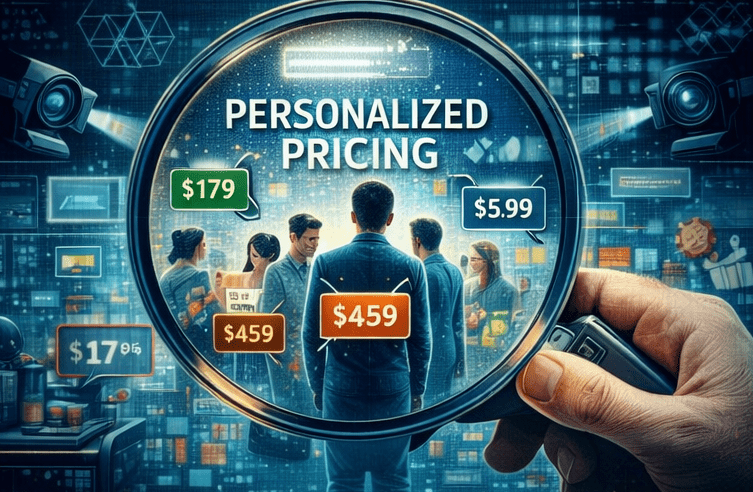
Surveillance pricing refers to the practice of adjusting prices, discounts, or offers based on data collected about a consumer’s behavior.
This includes signals like:
- Purchase history
- Browsing activity
- Location
- Device type
- Timing and frequency of purchases
- Loyalty program participation
Instead of one fixed price, companies increasingly estimate your willingness to pay—and adjust accordingly.
In simple terms:
You don’t pay “the price.” You pay your price.
The Shift: From Product-Based to Person-Based Pricing
Historically:
- Prices were based on cost, competition, and margin
Now:
- Prices are based on predicted consumer behavior
This shift is driven by:
- Data collection at scale
- AI and machine learning models
- Digital ecosystems (apps, accounts, loyalty programs)
The result is a feedback loop:
- You behave a certain way
- The system learns from it
- It adjusts future pricing or offers
- Your next behavior is influenced
Over time, this becomes highly optimized—for the retailer.
But it can also be optimized—for you.
Where Surveillance Pricing Is Already Happening
1. Grocery (The Everyday Entry Point)
In Canada, grocery stores haven’t fully adopted visible dynamic pricing—but they’ve built something just as powerful: personalized incentives.
Programs like PC Optimum (Loblaws) track:
- What you buy
- How often you buy
- Whether you wait for deals
Two shoppers can walk into the same store and pay the same shelf price—but receive completely different offers, points, and discounts.
👉 The shelf price is fixed.
👉 The effective price is personalized.
2. Travel (The Original Dynamic Pricing Engine)
Airlines and hotels have long used behavior-driven pricing:
- Prices increase with repeated searches
- Timing, demand, and urgency signals affect cost
- Location and device may influence displayed prices
This is one of the most advanced forms of real-time pricing optimization.
3. E-commerce
Online retailers:
- Update prices multiple times per day
- Personalize recommendations and discounts
- Test different pricing strategies across users
Even when base prices aren’t personalized, the purchase environment is.
4. Food Delivery Apps
Platforms like Uber Eats and DoorDash:
- Adjust delivery fees based on demand and timing
- Offer personalized promotions
- Control visibility of restaurants algorithmically
Two users can open the same app and see different incentives.
5. Telecom
- New customers get better deals than existing ones
- Retention offers appear when you try to cancel
- Pricing becomes negotiable based on behavior
Loyalty often leads to higher prices, not lower.
6. Automotive & Insurance
- Car pricing is influenced by negotiation signals and urgency
- Insurance pricing is highly personalized:
- Driving data
- Risk profiles
- Behavioral tracking
This is surveillance pricing under the label of “risk-based pricing.”
7. Housing
Rental pricing software dynamically adjusts rent based on:
- Demand
- Vacancy rates
- Market conditions
Prices can change daily—even for identical units.
This is one of the most controversial implementations today.
8. Healthcare & Pharma
- Insurance premiums vary by personal data
- Medical pricing differs across providers and plans
- Drug discounts and coupons are targeted
The system doesn’t always show different prices—but it produces different outcomes.
Online vs In-Store: What’s the Difference?
Online:
- Prices themselves can change
- Fully dynamic and personalized
- Real-time experimentation
In-Store:
- Shelf prices are mostly fixed
- Personalization happens through:
- Loyalty programs
- Coupons
- App-based offers
Online changes the price.
In-store changes your discount.
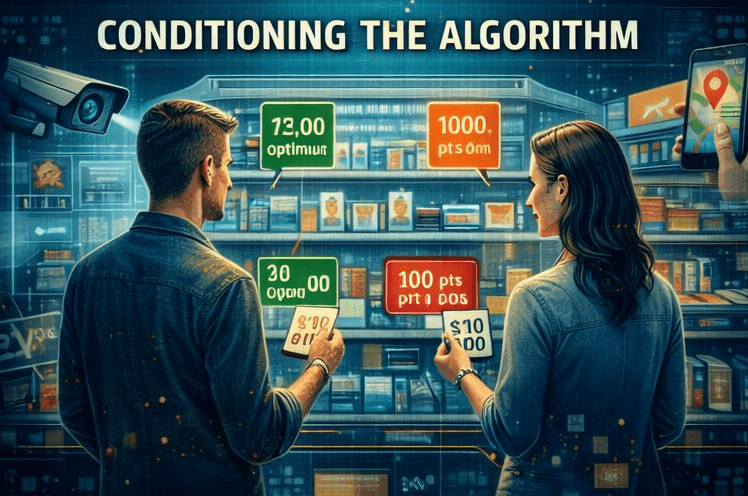
The PC Optimum Playbook: How to “Train” the Algorithm
Loyalty programs are one of the clearest examples of surveillance pricing in action—and one of the easiest to influence.
Here’s how to make the system work for you:
-
Stop buying items at full price
If you consistently pay full price, you signal low price sensitivity.
Pause purchases and offers often appear within 1–3 weeks. -
Avoid predictable patterns
Rotate categories instead of buying the same items every week.
Variability triggers new promotions. -
Signal intent without purchasing
Browse products, add to cart, or scan items—but don’t always complete the purchase.
This can generate targeted offers. -
Split spending across accounts
Using multiple profiles prevents overtraining a single account and can increase total offers. -
Don’t always maximize offers
Fully redeeming every deal signals the current incentive is sufficient.
Occasional restraint can lead to better future offers. -
Use “Spend X, Get Y” strategically
Only engage when your natural spend is close to the threshold.
Avoid stretching your budget just to hit rewards.
The mindset shift:
You’re not collecting points—you’re conditioning an algorithm.
The Psychology Behind Surveillance Pricing
At its core, this system is built on behavioral economics:
Companies are measuring:
- Price sensitivity
- Urgency
- Habit formation
- Switching behavior
And adjusting incentives to maximize:
- Conversion
- Basket size
- Lifetime value
Consumers who are:
- Predictable
- Loyal
- Convenience-driven
…tend to pay more over time.
Consumers who are:
- Flexible
- Deal-sensitive
- Strategically inconsistent
…tend to receive better offers.
The Risks and Controversies
Surveillance pricing raises important concerns:
- Fairness: Are different people paying different prices for the same product?
- Transparency: Most consumers don’t realize this is happening
- Data usage: How much personal data is being used to influence pricing?
- Market manipulation: Especially in housing and essential goods
Regulators are beginning to pay attention—but the systems are evolving faster than policy.
The Future of Pricing
We are moving toward a world where:
- There is no single “market price”
- Pricing is continuously optimized per individual
- Algorithms—not humans—set incentives
This doesn’t mean consumers are powerless.
It means the rules have changed.
Final Takeaway
Surveillance pricing isn’t just a retail tactic—it’s a structural shift in how markets operate.
The key insight is simple:
Your behavior shapes your price.
The more you understand that, the more you can influence the outcome.
Because in this new system, the most valuable skill isn’t just finding deals—
It’s knowing how to make the system offer you better ones.