

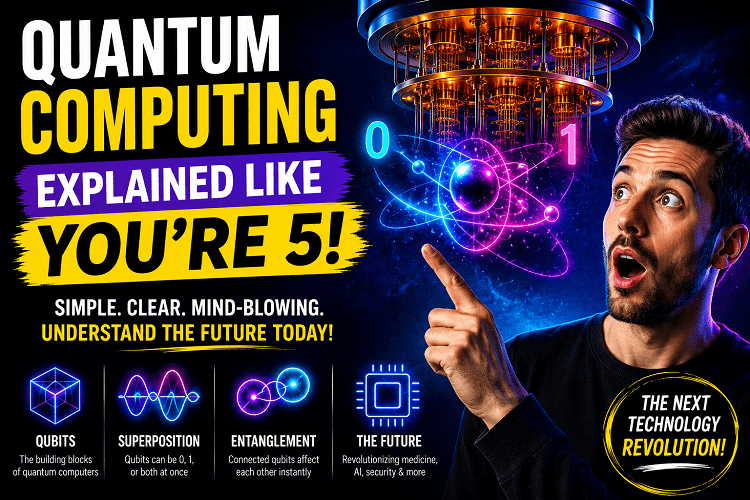
Quantum computing is one of those topics people pretend to understand at dinner parties.
Someone says:
“Quantum computers use qubits and superposition.”
Everyone nods.
Nobody actually knows what that means.
So let’s fix that.
This guide explains quantum computing in plain English — no physics degree, no confusing math, no sci-fi nonsense. By the end, you’ll understand:
- what quantum computers actually are,
- why they matter,
- how they differ from normal computers,
- what “qubits” and “superposition” mean,
- and whether quantum computers are really going to change the world.
First: What Is a Normal Computer?
Your laptop, phone, Xbox, and even giant supercomputers all work basically the same way.
They use tiny electrical switches called bits.
A bit can only be one of two things:
0 or 1
That’s it.
Everything your computer does — YouTube, TikTok, games, spreadsheets, AI — is built from billions of tiny ON/OFF decisions.
Think of a normal computer like a massive army of light switches.
Each switch is either:
- OFF (0)
- ON (1)
Regular computers are incredibly fast, but they still check possibilities mostly one step at a time.
Quantum Computers Work Completely Differently
Quantum computers use something called a qubit instead of a normal bit.
A qubit is weird.
It can be:
- 0,
- 1,
- or BOTH at the same time.
∣ψ⟩=α∣0⟩+β∣1⟩
That strange “both at once” behavior is called superposition.
If that sounds impossible, welcome to quantum physics.
The Spinning Coin Analogy
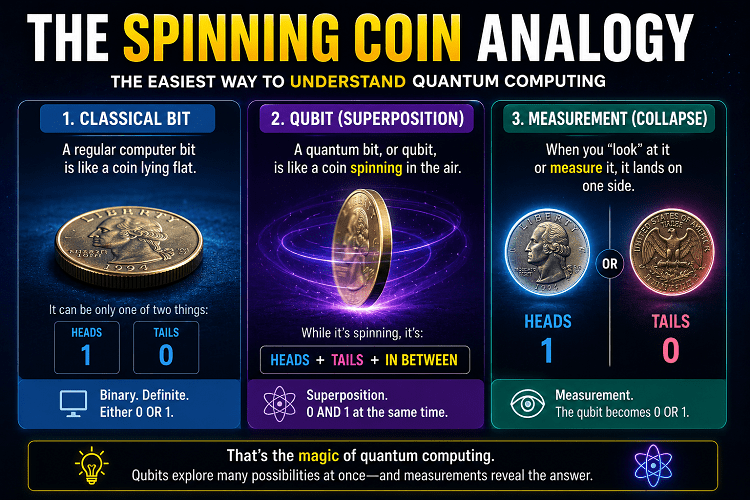
A regular computer bit is like a coin lying flat on a table:
- heads = 1
- tails = 0
Simple.
A qubit is like a coin spinning in the air.
While it’s spinning, it’s kind of:
- heads,
- tails,
- and somewhere in between.
Only when you “look” at it does it finally settle into one result.
That’s the core idea behind quantum computing.
Why Is That Powerful?
Because quantum computers can explore many possibilities simultaneously.
Imagine trying to solve a maze.
A Normal Computer
A normal computer tries:
- left,
- then right,
- then another path,
- then another.
Very fast — but still mostly sequential.
A Quantum Computer
A quantum computer can explore huge numbers of paths at once using quantum behavior.
Not magic.
Not infinite speed.
But for certain problems, dramatically faster.
What Is Superposition?
Superposition is the famous “multiple states at once” concept.
A classical bit:
b∈{0,1}
A qubit:
∣ψ⟩=α∣0⟩+β∣1⟩
That means the qubit behaves like a probability wave until measured.
This is why people describe quantum physics as “weird.”
Because it genuinely is weird.
Even physicists admit this.
What Is Entanglement?
Now things get extra strange.
Qubits can become connected in a way called entanglement.
When qubits are entangled:
- changing one instantly affects the other,
- even if they’re far apart.
Einstein famously called this:
“spooky action at a distance.”
Entanglement lets quantum computers coordinate massive calculations in ways classical computers cannot.
So Are Quantum Computers Just Faster Computers?
No.
This is one of the biggest misconceptions.
Quantum computers are NOT better at everything.
They are only better at specific kinds of problems.
For example:
| Problem Type | Quantum Advantage? |
|---|---|
| Web browsing | No |
| Watching Netflix | No |
| Word documents | No |
| Weather simulation | Potentially |
| Drug discovery | Potentially huge |
| Cryptography | Very important |
| Optimization problems | Often yes |
Quantum computers won’t replace your MacBook.
They’ll likely work alongside classical computers.
What Are Quantum Computers Good At?
1. Drug Discovery
Molecules behave according to quantum physics.
Classical computers struggle to simulate complex molecules accurately.
Quantum computers could potentially model them naturally, helping:
- medicine development,
- protein folding,
- material science,
- battery design.
2. Breaking Encryption
This is the scary one.
Modern internet security relies on math problems that are extremely hard for classical computers.
Quantum algorithms like Shor’s Algorithm could solve some of those problems much faster.
That means future quantum computers could potentially crack:
- certain banking encryption,
- passwords,
- secure communications.
Which is why governments and cybersecurity companies are already developing “post-quantum cryptography.”
3. Optimization Problems
Quantum computers may become amazing at finding optimal solutions.
Examples:
- delivery routes,
- airline scheduling,
- traffic systems,
- stock market modeling,
- supply chain optimization.
Basically:
“What’s the best possible combination among millions of choices?”
That’s where quantum shines.
Why Don’t We All Have Quantum Computers Already?
Because they are incredibly fragile.
Tiny disturbances ruin calculations.
This problem is called decoherence.
Quantum computers often need:
- temperatures colder than outer space,
- vacuum chambers,
- extreme isolation,
- complex error correction systems.
Some quantum computers operate near absolute zero:
T≈−273.15∘C
That’s absurdly cold.
The Biggest Challenge: Errors
Qubits are delicate.
Very delicate.
Heat, vibration, radiation, or tiny environmental noise can destroy calculations.
This is why modern quantum computers are still:
- experimental,
- noisy,
- error-prone,
- and difficult to scale.
We are still in the early days.
Think:
“Quantum computing in 2026 is like regular computers in the 1940s.”
Promising, but immature.
What Companies Are Leading Quantum Computing?
Major players include:
- IBM
- Microsoft
- Intel
- D-Wave
- IonQ
- Rigetti
Governments are also investing billions because quantum computing has:
- economic,
- scientific,
- military,
- and cybersecurity implications.
What Is Quantum Supremacy?
This is when a quantum computer performs a task impossible for classical supercomputers within reasonable time.
Google claimed a milestone in 2019 when its quantum processor solved a specialized problem extremely quickly.
Critics argued the benchmark was narrow.
But the point remains:
quantum computing is progressing fast.
Will Quantum Computers Replace AI?
Probably not.
But they may enhance AI.
Quantum systems could potentially:
- speed up machine learning,
- optimize neural networks,
- process huge search spaces more efficiently.
Most experts expect hybrid systems:
- classical computers + AI + quantum accelerators.
Common Quantum Computing Myths
Myth #1: Quantum Computers Are Magic
Nope.
They obey physics.
Very weird physics.
But still physics.
Myth #2: They’ll Replace Normal Computers
Unlikely.
Your phone is still better for everyday tasks.
Quantum machines are specialized tools.
Myth #3: Quantum Computers Can Solve Everything Instantly
Absolutely false.
Some problems get huge speedups.
Others get none.
Myth #4: We Already Have Fully Functional Quantum Computers
Not really.
Current systems are early-stage and noisy.
The Simplest Way to Understand Quantum Computing
Here’s the easiest summary:
A normal computer tries possibilities one by one.
A quantum computer uses the strange rules of quantum physics to explore many possibilities simultaneously and amplify the right answers.
That’s the big idea.
Final Thoughts
Quantum computing is real.
It’s not science fiction anymore.
But it’s also not the magical instant-solution machine people imagine.
Right now, quantum computing is:
- experimental,
- expensive,
- fragile,
- and highly specialized.
Yet it could eventually transform:
- medicine,
- cryptography,
- AI,
- logistics,
- chemistry,
- and materials science.
The important thing to remember is this:
Quantum computers are not “super laptops.”
They are entirely new kinds of machines built around the bizarre rules of the quantum universe.
And honestly?
Even scientists still find them weird.